Great Wildebeest Migration

Africa’s Greatest Wildlife Spectacle
The Great Wildebeest Migration: Dates, Routes & Best Time to Visit
Over 1.5 million wildebeest thunder across Tanzania and Kenya every year. Here is everything you need to witness it.
🌍 Tanzania · Kenya · Year-Round Guide
The great wildebeest migration is widely regarded as the greatest wildlife spectacle on Earth. Every year, more than 1.5 million wildebeest — joined by hundreds of thousands of zebras and gazelles — complete a 1,800-kilometre circular journey across the Serengeti in Tanzania and the Masai Mara in Kenya. This relentless, instinct-driven movement is powered entirely by the search for fresh grass and water. No force stops it. No calendar governs it. And yet, it is remarkably predictable — making it one of the most rewarding experiences a traveller can plan for in Africa.
1.5M+ Wildebeest in the great migration
1,800km Annual circular route
12 Months of movement — never stops
What Is the Great Wildebeest Migration?
The great wildebeest migration in Africa is not a single event — it is a continuous, year-round cycle that takes place across the Serengeti-Mara ecosystem, one of the most biodiverse landscapes on the planet. The herds move in a broad clockwise loop through southern Tanzania’s Serengeti National Park, across the Grumeti River in western Serengeti, northward into Kenya’s Masai Mara National Reserve, and then back south again as rainfall patterns shift.
What makes this great migration of wildebeest and zebra so extraordinary is the scale of predation it triggers. Lions, cheetahs, leopards, hyenas, and Nile crocodiles are all drawn to the moving columns of animals. At every river crossing, the tension between survival and instinct plays out in full view of safari vehicles. It is raw, dramatic, and deeply moving.
Is the Great Migration Worth It?
Absolutely — and experienced safari travellers consistently rank it among the most powerful wildlife experiences of their lives. However, the “worth it” factor is heavily tied to timing. Visitors who align their trip with the calving season in the southern Serengeti or the dramatic Mara River crossings in August and September tend to describe it as life-changing. Those who arrive without planning may see large herds but miss the defining moments.
The honest answer is this: if you plan well, the great wildebeest migration is worth every kilometre of the journey.
Great Wildebeest Migration Dates: Month-by-Month
Understanding the great wildebeest migration dates requires appreciating that the herds respond to rainfall and grass growth — not the calendar. The timeline below represents the typical annual pattern, though slight variations occur each year.
Jan – Feb
Calving Season — Southern Serengeti & NdutuAround 8,000 calves are born daily in February, attracting dense predator activity across the open Ndutu plains.
Mar – Apr
Northward March — Central SerengetiThe long rains begin and the herds start moving toward Seronera and the central Serengeti in long, dusty columns.
May – Jun
Western Corridor — Grumeti River CrossingsThe first river crossings of the year take place at the crocodile-filled Grumeti River. Less crowded, equally dramatic.
Jul – Aug
Peak Season — Northern Serengeti & Kenya BorderThe great migration Serengeti August period brings the highest concentration of wildebeest near the Mara River. Crossings intensify.
Aug – Oct
Mara River Crossings — Great Wildebeest Migration at Mara River, KenyaThe most iconic phase. Thousands of animals plunge into the Mara River as crocodiles surge. The great wildebeest migration Tanzania and Kenya overlap during this window.
Nov – Dec
Return South — Eastern SerengetiShort rains trigger the southward return. The herds cross back into Tanzania, completing the annual circuit.
Great Wildebeest Migration at Mara River, Kenya
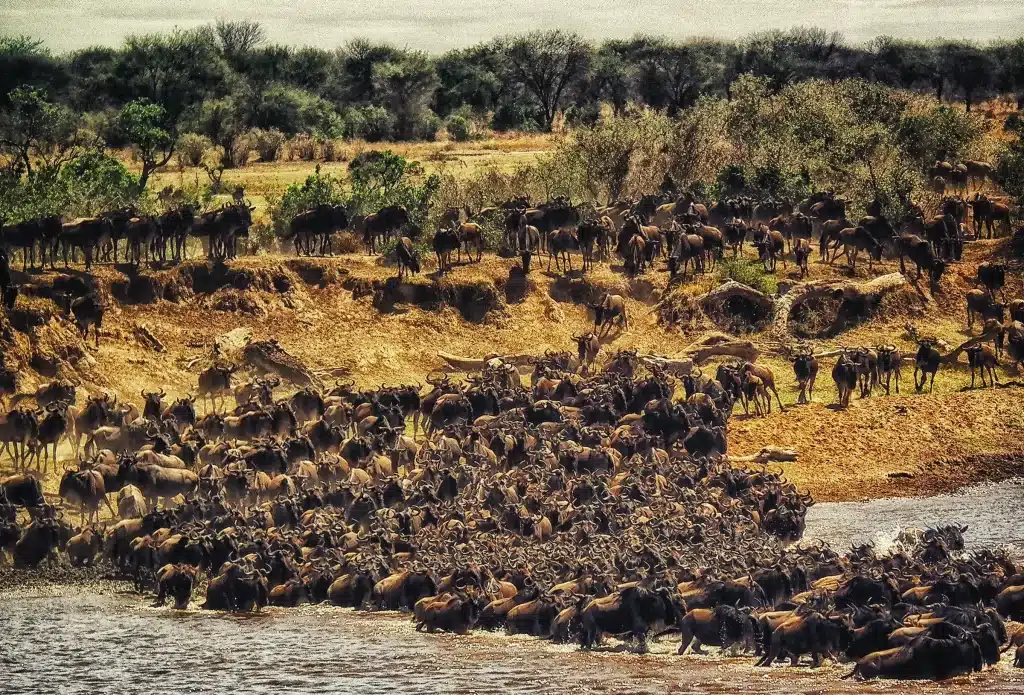
Of all the stages in the great wildebeest migration across Africa, the Mara River crossings are the most photographed and most sought-after. The great wildebeest migration at Mara River Kenya typically peaks between late July and October. During this period, the herds gather in enormous numbers on the Tanzanian bank, pacing nervously before the instinct to cross finally overcomes their fear.
When a crossing begins, it is sudden and all-consuming. Thousands of animals pour into the churning river simultaneously. Crocodiles, some exceeding four metres in length, surge from the water. Calves struggle against the current. The bank on the Kenyan side becomes a stampede of hooves and dust. It is terrifying, extraordinary, and humbling all at once.
The crossings are unpredictable by nature — a herd may turn back several times before committing. Consequently, spending at least three to five days in the Mara Triangle or northern Serengeti greatly improves your chances of witnessing one. This patience is consistently rewarded.
Great Migration Serengeti: August Highlight
August is considered the single best month to witness the great migration in the Serengeti ecosystem. By early August, the bulk of the 1.5 million wildebeest have moved into the northern Serengeti and begun their crossings into the Masai Mara. Game drives during this window are exceptionally productive — predators such as lions and cheetahs are constantly active, while vultures and eagles circle overhead.
Visitors who choose the great migration Serengeti August experience benefit from dry, cool weather, excellent road conditions, and near-daily river crossing activity near Kogatende in northern Serengeti. That said, August is peak season, so accommodation should be booked at least six to twelve months in advance. Luxury tented camps near the Mara River — the so-called “crossing camps” — are in extremely high demand and fill rapidly.
How Many Wildebeest Are in the Great Migration?
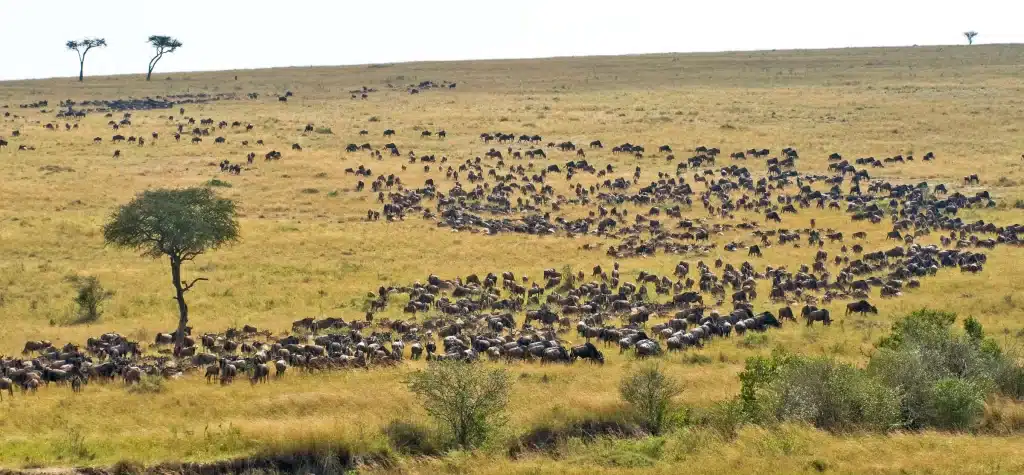
Approximately 1.5 to 2 million wildebeest are estimated to participate in the great migration annually. These are accompanied by around 500,000 Thomson’s gazelles and 200,000 zebras, making the total number of animals in motion well over 2 million at any given time. The wildebeest alone cover enormous distances — the Serengeti-Mara ecosystem spans roughly 40,000 square kilometres, and the herds move continuously through all of it.
Calving season in February gives a vivid sense of the population’s scale. Approximately 400,000 to 500,000 calves are born in the southern Serengeti in the span of just a few weeks, representing one of the largest simultaneous birthing events in the natural world. Predator populations — lions, hyenas, wild dogs, leopards, and cheetahs — all peak in the Ndutu and Ngorongoro corridor during this period, drawn in by the abundance of vulnerable young.
Great Wildebeest Migration in Tanzania and Kenya: Key Locations
The great wildebeest migration Tanzania and Kenya experience covers several distinct zones, each offering a different character of wildlife encounter.
Southern Serengeti & Ndutu Plains, Tanzania
This is where the great migration of wildebeest and zebra is “born” each year. The short-grass plains of Ndutu receive the nutrient-rich runoff that triggers calving. The open landscape makes predator-prey interactions easy to observe. January through March is the optimal window.
Grumeti River, Western Serengeti
Often overlooked in favour of the Mara, the Grumeti crossings in June and July are a genuine hidden gem. The river is narrower and faster-moving, making crossings look just as dramatic with fewer safari vehicles in attendance.
Northern Serengeti — Kogatende & Lamai Wedge
From July through October, this is the epicentre of great wildebeest migration activity. The Mara River forms the border between Tanzania and Kenya here, and crossing points are well-known. Camps positioned on elevated ridges above the river offer unobstructed views of approaching herds.
Masai Mara National Reserve, Kenya
The great wildebeest migration at Mara River Kenya is the defining visual of the whole cycle. The Mara Triangle — the western section of the reserve — receives the bulk of the arriving herds and sees the most frequent crossings. Year-round predator density in the Mara is among the highest in Africa, making this equally rewarding even outside migration season.
When to See the Great Wildebeest Migration: A Practical Guide
The most common question travellers ask is: when exactly is the great wildebeest migration? The answer depends on what kind of experience you are seeking.
- Forriver crossings: Plan for July through October, with August and September offering the highest frequency at the Mara River.
- Forcalving season and predator action: January through March in the southern Serengeti and Ndutu. Less dramatic than a crossing, but arguably more emotionally powerful.
- Forsmaller crowds: The Grumeti River crossings in June provide a similarly thrilling experience with far fewer vehicles.
- Fora complete overview: A 7- to 10-day itinerary combining southern Serengeti and the Mara — timed for late July through September — covers the greatest diversity of migration phases.
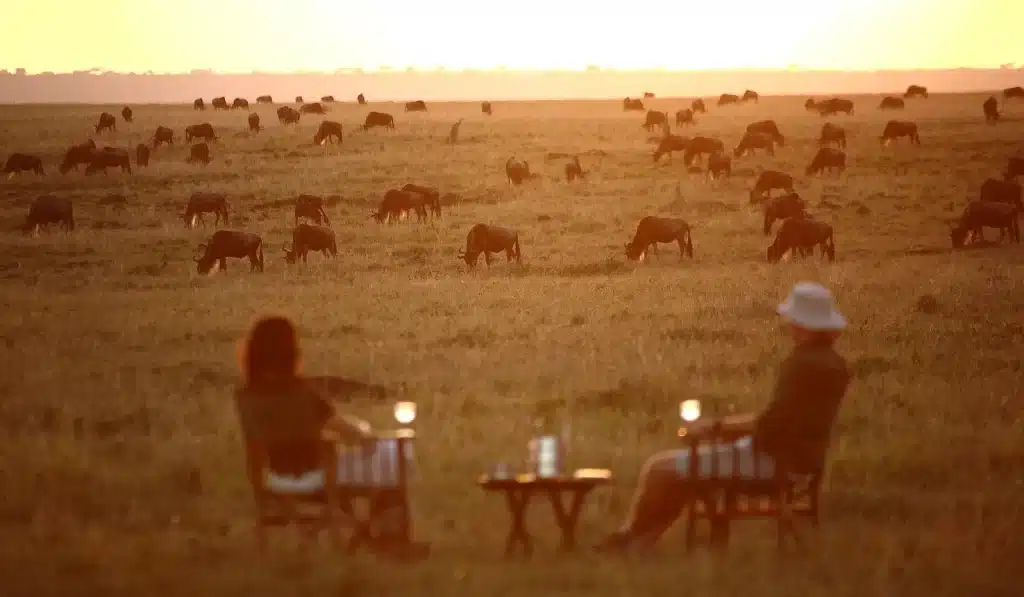
Dry seasons in Tanzania (June–October and January–February) coincide with the most dramatic migration moments and the best game-viewing conditions overall. Roads are passable, skies are clear, and animals concentrate around water sources.
Planning Your Great Wildebeest Migration Safari
Witnessing the great wildebeest migration in Africa requires thoughtful preparation. The following considerations are consistently highlighted by experienced safari guides and returning travellers.
- Book early.Camps near the Mara River sell out 8–12 months ahead for August and September dates. Off-peak windows (November–May) allow shorter booking lead times.
- Choose mobile camps carefully.Migration follows the grass, not a fixed location. Mobile tented camps that reposition seasonally keep you closest to the action throughout the year.
- Allow at least three nights per zone.River crossings do not happen on demand. Budget enough time at each location to increase the likelihood of witnessing one.
- Combine Tanzania and Kenya.Flying between Serengeti and Masai Mara takes under two hours and allows you to follow the herds across the international border — the most complete way to experience the migration.
- Use an expert guide.Experienced naturalist guides read animal behaviour, weather patterns, and herd movements to anticipate crossings before they happen.
- Pack the right gear.A long telephoto lens (300–500mm), quality binoculars, dust-proof bags, and layered clothing are essential for early-morning game drives.
Frequently Asked Questions
When is the best time for the great wildebeest migration?
The most dramatic moments occur from July to October when the Mara River crossings take place. However, the calving season in January and February in the southern Serengeti is equally spectacular and far less crowded.
How many wildebeest are in the great migration?
Approximately 1.5 to 2 million wildebeest participate annually, alongside 200,000 zebras and 500,000 gazelles. Together, over 2 million animals are in motion across the Serengeti-Mara ecosystem at any given time during the year.
Is the great wildebeest migration worth it?
Yes — for travellers who plan thoughtfully, it is widely regarded as the most extraordinary wildlife experience in Africa. The key is timing your visit to coincide with a specific phase of the migration, whether calving, Grumeti crossings, or the Mara River crossings.
Does the great wildebeest migration happen in both Tanzania and Kenya?
Yes. The great wildebeest migration Tanzania and Kenya is a single cross-border ecosystem event. The herds spend most of the year in Tanzania’s Serengeti and move into Kenya’s Masai Mara from approximately July through October before returning south.
What happens at the Mara River during the great migration?
The great wildebeest migration at Mara River Kenya involves massive herds crossing the crocodile-filled Mara River between Tanzania and Kenya. Thousands of animals plunge in simultaneously, with large Nile crocodiles and predators on both banks. It is the most photographed wildlife event in the world.
Ready to Witness the Great Wildebeest Migration?
Steady Safaris crafts expertly timed itineraries that put you in exactly the right place at the right moment — whether it is a calving sunrise in Ndutu or a thunderous Mara River crossing.