
Happy Clients Reviews
This was our second trip with Carlos & Steady Safari, and it was just as fun as the first. I travelled with the same travelling buddy - both of us females - and Carlos always makes us feel safe and cared for during the journey. July 4th 2025
LEE, ARKANSAS USAMy wife and I spent a thoroughly enjoyable week with Carlos, split between Queen Elizabeth Park and Bwindi Impenetrable Forest. He is delightful company, giving us great insights into the country and its culture. Date of experience: 12 Feb 2025
PROF RICHARD CHANDLER CALIFORNIAOur family of 5 has just returned from 7 days safari with Steady Safaris Ltd. Our guide was Carlos, who organized the itinerary for the trip. We gave him an idea of what we would like to do, and he then came back with his expertise. Date of experience: 28 March 2025
JOANNE UK, YorkMagnificent Experience didn't disappoint! Our trip to Murchison Falls national park in Uganda was the third experience we have enjoyed with Steady Safaris Limited. They do what they do do VERY well! I can book with complete confidence that they have researched each trip and every option to be the best on offer. Date of experience: 28 April 2025
GEORGINA, FLORIDA, USAGreat experience with Carlos and Steady Safaris Limited Highly recommending Carlos and Steady Safaris Limited to anyone who needs little or a lot of help with their trip planning. Carlos came to the rescue when I was going nowhere in trying to plan for our Uganda trip. He was the only one that actually called me back after I submitted so many quote/inquiry emails with other agencies I found online. Date of experience: 01 April 2025
LILY, SOUTH CAROLINA, USA
Lake Mburo National Park
Discover Lake Mburo National Park
Lake Mburo National Park is one of Uganda’s most accessible wildlife destinations and an excellent stop on a western Uganda safari. Located in the Ankole region, approximately 240 km from Kampala, the park is characterized by rolling hills, open savannah, acacia woodland, wetlands and a network of lakes. It is particularly famous for its large populations of zebras, impalas, elands, buffaloes, waterbuck and warthogs, while predators include leopards and spotted hyenas. Unlike many Ugandan savannah parks, Lake Mburo can be explored on foot, by boat, bicycle and even horseback in selected areas. The park is also an important birding destination and offers a peaceful introduction to Uganda’s wildlife before continuing toward Bwindi, Queen Elizabeth National Park or other western safari destinations.
Getting There
Lake Mburo National Park is approximately 240 km from Kampala, making it one of Uganda’s easiest national parks to reach by road. The journey generally takes around 3½–4 hours, depending on traffic, road conditions and stops. The usual route follows the Kampala-Masaka-Mbarara highway before turning toward the Sanga or Nshara entrances.
The park is generally accessible during daytime visiting hours, approximately 7:00 AM to 7:00 PM. Specific activities, including guided walks, boat trips and night experiences, operate according to their own schedules and should be arranged in advance.
Things to Do in Lake Mburo National Park
Game Drives
Game drives provide an excellent introduction to Lake Mburo’s diverse wildlife. The savannah and woodland tracks offer opportunities to see zebras, impalas, elands, waterbuck, buffaloes, warthogs and topi. Leopards and hyenas are more elusive, but experienced guides know areas where their tracks and movements are commonly observed.
Boat Cruise
A boat cruise on Lake Mburo provides a different perspective of the park. The water supports hippos, crocodiles and numerous waterbirds, while animals such as buffaloes and antelopes may be seen drinking along the shoreline. The calm waters and surrounding hills also make the cruise excellent for photography and bird watching.
Walking Safari
Lake Mburo is one of Uganda’s special destinations for walking safaris. Accompanied by a trained ranger, visitors can explore the savannah on foot while learning about animal tracks, plants, birds and smaller wildlife. Walking provides an intimate experience and allows travelers to appreciate details that may be missed from a vehicle.
Sport Fishing
Sport fishing is available on Lake Mburo under regulated conditions. Anglers can enjoy fishing from selected areas of the lake while surrounded by beautiful scenery and wildlife. Fishing is particularly appealing to travelers looking for a quieter activity away from conventional game drives. Equipment and arrangements should be confirmed before the excursion.
Bird Watching
Lake Mburo is an excellent birding destination because its lakes, wetlands, woodland and open grasslands support a wide range of species. Birders can search for waterbirds around the lake, while Rubanga Forest and other woodland areas provide opportunities for forest and savannah species. Guided birding walks can reveal many species that are easily overlooked from a vehicle.
Cycling
Cycling is one of the most distinctive ways to explore the Lake Mburo area. Guided bicycle excursions can take travelers through savannah and community landscapes where zebras, impalas, Ankole cattle and other wildlife may be encountered. Cycling provides an active safari experience and allows visitors to travel at a slower pace while enjoying the surrounding scenery.
Wildlife of Lake Mburo National Park
Leopards
Leopards are among Lake Mburo’s most elusive predators. They are generally solitary and mainly active around dawn, dusk and during the night. Their presence is often revealed through tracks and other signs rather than direct sightings. Patient visitors may occasionally see a leopard moving through woodland, grassland or areas with dense vegetation.
Spotted Hyena
Spotted hyenas are important predators and scavengers within Lake Mburo’s ecosystem. They are highly social animals that live in clans and can cover large distances while searching for food. Sightings may occur during early morning or evening drives, while tracks and calls can provide evidence of their presence even when the animals remain hidden.
African Buffalo
African buffaloes are among the larger herbivores found throughout Lake Mburo National Park. They can occur in herds and are commonly associated with grasslands, wetlands and areas around water. Their powerful appearance and impressive horns make them popular wildlife photography subjects, although visitors should always maintain a safe distance.
Hippopotamus
Hippos are closely associated with Lake Mburo and its surrounding wetlands. During the heat of the day, they spend much of their time in water before emerging to graze, mainly at night. Boat cruises provide excellent opportunities to observe them in the lake, while guided walks may reveal hippo tracks and grazing areas.
Antelopes of Lake Mburo
Eland
The eland is one of the largest antelopes in Africa and is one of Lake Mburo’s most impressive herbivores. These powerful antelopes are often seen in open grassland and woodland, sometimes in small groups. Their large size, distinctive body shape and spiral horns make them rewarding subjects for wildlife photographers.
Impala
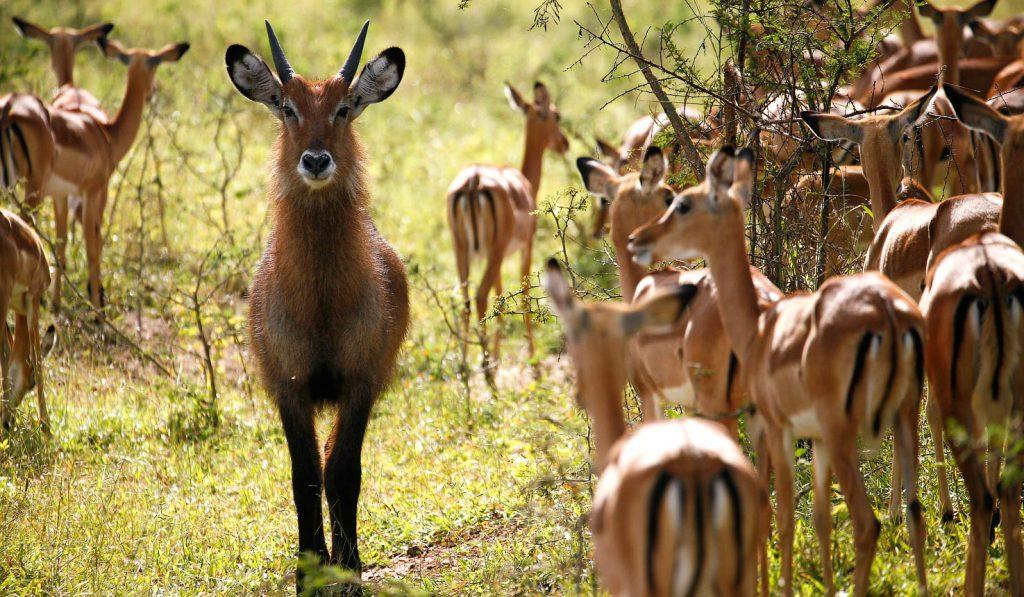
Impala are among the most characteristic antelopes of Lake Mburo and occur in large numbers. Their reddish-brown coats, white underparts and elegant curved horns make them easy to recognize. They are highly agile and can leap considerable distances when escaping predators. Large concentrations can often be seen around the park’s open savannah.
Waterbuck
Waterbuck are large, robust antelopes that prefer areas close to water and vegetation. Their shaggy coats and distinctive white rump markings make identification relatively easy. At Lake Mburo, they can be seen around wetlands, lake shores and grassy areas, usually remaining alert to the presence of predators.
Bushbuck
Bushbucks are shy forest and woodland antelopes that prefer areas with dense vegetation. They are usually encountered alone or in pairs and can be difficult to spot because their coloration provides excellent camouflage. Quiet game drives and walking safaris can increase the chances of encountering these secretive animals.
Eland
Elands deserve special attention because Lake Mburo is one of the places in Uganda where travelers have a good opportunity to encounter them. They are powerful yet surprisingly graceful antelopes that browse and graze across woodland and grassland. Their large size and spiral horns make them particularly impressive when seen at close range.
Warthog
Warthogs are common residents of Lake Mburo’s open grasslands. They are easily identified by their large heads, facial warts and curved tusks. Warthogs often graze on their knees and raise their tails when running. They may also retreat backward into burrows when threatened by predators such as lions or leopards.
Mongooses
Banded Mongoose
Banded mongooses are social carnivores that live in groups and spend much of their day foraging on the ground. Their alternating dark and pale bands give them a distinctive appearance. They feed on insects, small reptiles, eggs and other prey. Groups may sometimes be seen crossing safari tracks or moving between bushes.
Slender Mongoose
The slender mongoose has a long, narrow body, short legs and a long tail. It is an agile hunter that feeds on insects, rodents, reptiles and other small animals. Unlike banded mongooses, slender mongooses are commonly encountered alone. Their quick movements can make sightings brief but exciting during game drives.
White-Tailed Mongoose
The white-tailed mongoose is a relatively large mongoose with a dark body and pale tail. It is primarily nocturnal, which makes it difficult to encounter during conventional daytime game drives. Its diet includes insects and small animals. Specialized night wildlife activities provide better opportunities to observe this secretive species.
Common Dwarf Mongoose
The common dwarf mongoose is one of Africa’s smallest mongooses and lives in close-knit social groups. It spends daylight hours searching for insects and other small prey. These active little carnivores may be seen moving rapidly through grass and bushes, often with several members of the group remaining close together.
River Otter
Otters are associated with the aquatic environment around Lake Mburo and its wetlands. They are excellent swimmers and feed on fish, crustaceans and other aquatic prey. Sightings are not guaranteed because otters are secretive and fast-moving, but visitors exploring the lake and surrounding waterways may occasionally observe one swimming or feeding.
Monkeys and Primates
Olive Baboon
Olive baboons are adaptable primates found across Lake Mburo’s savannah, woodland and forest-edge habitats. They live in social groups and spend their time feeding, grooming, travelling and caring for young. Baboons are relatively easy to encounter during game drives and may sometimes be seen along roads or around open clearings.
Vervet Monkey
Vervet monkeys are agile and social primates that occupy woodland and savannah habitats. Their greyish coats and dark faces make them recognizable, while their lively movements often attract attention. They feed on fruits, leaves, flowers, insects and other foods and can frequently be seen moving between trees and the ground.
Reptiles
Nile Crocodile
Nile crocodiles inhabit Lake Mburo and other suitable waterways within the park. They can often be observed resting along the shoreline or floating quietly in the water. Boat cruises provide one of the best ways to see them while maintaining a safe distance. These powerful reptiles play an important role in the aquatic ecosystem.
Monitor Lizard
Monitor lizards are large reptiles that can occur around lakes, wetlands, woodland and savannah. They are strong swimmers and opportunistic predators, feeding on insects, eggs, fish, small animals and carrion. Their powerful limbs, long tails and alert behavior make them interesting sightings during wildlife excursions.
Snakes
Lake Mburo supports a variety of snake species across its grasslands, woodland, wetlands and other habitats. Some species are venomous while others are harmless. Most snakes are shy and avoid people, so sightings are relatively uncommon. Visitors should never approach, disturb or attempt to handle a snake encountered in the wild.
Chameleons
Chameleons are fascinating reptiles that inhabit suitable woodland and bush habitats around Lake Mburo. Their independently moving eyes, grasping feet and ability to change coloration help them survive in their environment. Because they are well camouflaged and move slowly, guided nature walks can offer better opportunities to locate them.
Lizards
Several species of lizards inhabit Lake Mburo’s varied ecosystems. They may be seen basking on rocks, tree trunks or open ground, while others remain hidden among vegetation. Their diets vary between species and can include insects, small animals, fruits and vegetation. Their quick movements make them enjoyable subjects for wildlife observation.
Geckos
Geckos are small reptiles found around trees, rocks, buildings and other sheltered areas. Many species are nocturnal and feed on insects and other small invertebrates. Their camouflage makes them difficult to notice during the day. Night activities can provide better opportunities to observe geckos moving and hunting after sunset.
Where to Stay in Lake Mburo National Park
Mihingo Safari Lodge
Mihingo Safari Lodge is one of the best-known luxury accommodation options in the Lake Mburo area. Set on a rocky outcrop overlooking the park, the lodge provides an immersive wilderness setting. Its accommodation, scenic views and access to safari activities make it especially attractive to travelers seeking a high-quality and distinctive Lake Mburo experience.
Arcadia Safari Lodge
Arcadia Cottages, sometimes referred to as Arcadia Safari Lodge, provides comfortable cottage accommodation close to Lake Mburo. Its elevated setting offers scenic views and convenient access to boat cruises, game drives and guided nature walks. It is particularly suitable for travelers seeking a comfortable mid-range base near the lake and park headquarters.
Mburo Safari Lodge
Mburo Safari Lodge provides safari-style accommodation within the Lake Mburo area. Its cottages and thatched structures blend with the natural environment, creating an atmosphere suited to a wildlife getaway. The lodge can be used as a base for game drives, boat trips, walking safaris and other activities around the park.
Rwakobo Rock
Rwakobo Rock is positioned on a scenic rocky outcrop near the Nshara Gate of Lake Mburo National Park. The lodge offers views across the surrounding savannah and provides a peaceful setting for travelers. Zebras, impalas, warthogs and other wildlife may be encountered around the area, adding to the safari atmosphere.
Eagle's Nest Lodge
Eagle’s Nest Lodge is a budget-friendly tented accommodation option situated on a hill outside the park boundary. Its elevated position provides impressive views across Lake Mburo’s savannah landscape. The permanent safari tents offer a simple bush experience and are suitable for travelers seeking affordable accommodation without giving up scenic surroundings.
Game Circuits in Lake Mburo National Park
Kazuma Track
The Kazuma Track leads toward the Kazuma area and provides opportunities to explore open savannah and rocky terrain. The route is particularly attractive for visitors interested in panoramic views and wildlife such as impala, zebra, eland and other antelopes. The Kazuma area also provides elevated viewpoints across parts of the park and surrounding lakes.
Ruroko Track
The Ruroko Track passes through a combination of open savannah and rocky hills. It connects with the wider game-track network and provides opportunities to search for antelopes, zebras and other wildlife. The rocky landscape can also be suitable habitat for klipspringers, making this route interesting for visitors looking beyond the park’s larger animals.
Kigambira Loop
The Kigambira Loop explores woodland and savannah around the Kigambira area. Historically, the route has been particularly useful for wildlife viewing during dry periods when animals concentrate around water and vegetation. Today, denser vegetation can make some sections more challenging for general game viewing, although the area remains interesting for birds and woodland wildlife.
Zebra Track
The Zebra Track is one of Lake Mburo’s best-known game-drive routes and takes its name from the large numbers of zebras commonly associated with the area. The route connects important sections of the park’s road network and passes through grassy landscapes where zebras, impalas, waterbuck and other herbivores can be observed.
Warukiri Track
The Warukiri Track passes through savannah where visitors can encounter impala, zebra, waterbuck, topi and buffalo. Its connection with other major tracks makes it useful for creating longer game-drive circuits. The area can be productive for wildlife viewing, particularly around grassy junctions where herbivores gather.
Research Track
The Research Track refers to routes and areas used for wildlife observation, ecological research and monitoring within the Lake Mburo ecosystem. Access and use may vary depending on conservation and management requirements. Travelers should follow guidance from park authorities and their safari guides when visiting research-sensitive areas.
Why Visit Lake Mburo National Park?
Lake Mburo National Park offers a safari experience that is distinctly different from Uganda’s larger savannah parks. Its compact size, accessible location and diverse landscapes make it ideal for short safaris from Kampala, while its wildlife and range of activities make it rewarding for longer stays.
A Lake Mburo safari can combine game drives, boat cruises, walking safaris, bird watching, cycling and sport fishing. The opportunity to explore parts of the park on foot or by bicycle adds a sense of adventure that is difficult to find in many other African safari destinations.
The park is also strategically positioned for travelers continuing toward Bwindi Impenetrable National Park, Queen Elizabeth National Park, Kibale Forest and southwestern Uganda. It is therefore an excellent first or final destination on a western Uganda safari.
For travelers planning a Uganda wildlife adventure, Steady Safaris can arrange customized Lake Mburo safari itineraries combining wildlife viewing, accommodation, transportation and other destinations across Uganda.
Travellers flying into Uganda can also consider domestic charter options. There are no direct flights into the park itself, but travellers can charter flights from Entebbe International Airport or Kajjansi Airstrip to Mbarara airstrip, followed by a road transfer to the park. For luxury travellers prioritising time, a fly-in and road-transfer arrangement can turn Lake Mburo into a comfortable addition to a high-end Uganda itinerary.
Wildlife in Lake Mburo National Park
Wildlife is at the heart of the Lake Mburo safari experience, and the park's compact nature can actually work in the traveller's favour. Instead of spending hours crossing huge distances between sightings, visitors can explore a mosaic of habitats where animals frequently move between grazing areas, woodland and water sources. The park is home to numerous mammal species, approximately 69 mammal species in its park-at-a-glance information.
One of the first animals many visitors hope to see is the Burchell's zebra. Large groups can often be encountered grazing in open areas, creating classic East African safari scenes. Zebra are particularly important to the identity of Lake Mburo because the park is one of Uganda's notable destinations for viewing them. Impala are another major attraction. Lake Mburo is the only Ugandan national park with a significant population of impala, making the species especially relevant to the park's conservation value.
The park also supports eland, one of Africa's largest antelopes, as well as topi, buffalo, waterbuck, reedbuck, warthog and bushbuck. Hippos inhabit the lakes, while crocodiles can be observed in suitable aquatic areas. Giraffes have also become part of the park's wildlife story following translocations from Murchison Falls National Park. UWA's park brochure notes the relocation of Rothschild's giraffes to Lake Mburo in 2015.
What does that mean for a visitor? It means every drive can feel slightly unpredictable. One bend might reveal zebra. Another may open onto a group of giraffes standing above the grassland. A woodland edge could hold an elusive leopard, while a lakeshore may reveal hippos resting in the water. Lake Mburo is not a destination where you should rush from one sighting to the next. Its charm lies in watching the landscape and allowing wildlife to reveal itself naturally.
Predators and Other Mammals
Although Lake Mburo is not marketed as a big-cat destination on the scale of some of Africa's famous predator parks, predators are part of its ecosystem. Leopards and spotted hyenas are present, although sightings are naturally less predictable than those of common herbivores. Official park information confirms the presence of these predators and notes that lions are once again being sighted in the park after periods of absence.
That distinction is important when planning expectations. A responsible safari operator should never promise a leopard or lion sighting. Wildlife moves according to food, water, weather, temperature and countless other variables. Instead, the excitement comes from entering an environment where the possibility exists. Early morning drives can be particularly rewarding because predators may still be active before the heat of the day changes animal behaviour.
The park's herbivore community is arguably its strongest wildlife attraction. Eland, topi, zebra and impala give Lake Mburo a character that differs from many other Ugandan parks. The absence of elephants is also ecologically significant because it allows woodland habitats to persist differently from areas where elephants heavily modify vegetation. The result is a landscape where grasses, acacia woodland, wetlands and rocky areas combine to create a varied visual experience.
For photographers, this diversity is a gift. You are not limited to one landscape composition. You can photograph zebra against open grassland, giraffes framed by acacia trees, impala in warm morning light or hippos surrounded by reflective water. With patience, even common species can produce extraordinary images. The best safari memories are often not the rarest animal sightings but the moments when light, landscape and wildlife unexpectedly align.
Bird Watching in Lake Mburo
Wetland and Savanna Bird Species
Birdwatchers should not treat Lake Mburo as an optional extra. The park and surrounding wetland system are among Uganda's important bird habitats, and UWA's park information lists more than 315 bird species.
The park's birding strength comes from habitat diversity. Papyrus wetlands support specialised species, while acacia woodland attracts another community of birds. Open grassland provides yet another environment. There are other species and habitats associated with papyrus, acacia woodland and wetland areas, while the Lake Mburo-Nakivale system is recognised under the Ramsar framework for its international wetland importance.
For serious birders, the possibility of finding wetland specialists is one of the biggest attractions. Species associated with the area include the shoebill, papyrus yellow warbler and African finfoot, alongside numerous waterbirds and savanna species. Lake Mburo-Nakivale ecosystem as an Important Bird Area and highlights its value for threatened and specialised wetland birds.
Even if you are not a dedicated birder, birds add another layer to the safari. A guide can explain calls, feeding behaviour and nesting sites while you are travelling between mammal sightings. Suddenly, a quiet stretch of woodland becomes interesting because your guide hears a species you would have missed completely. This is one of the pleasures of travelling with a knowledgeable local guide: the landscape becomes a living story rather than simply scenery outside the vehicle.
Things to Do in Lake Mburo National Park
Game Drives
A game drive in Lake Mburo National Park remains one of the easiest ways to explore the park. Morning drives offer cooler temperatures and good opportunities to encounter grazing herbivores, while afternoon drives can produce beautiful golden light. Night drives, where permitted and properly arranged, offer an entirely different perspective, with nocturnal species and predator activity becoming more relevant.
Boat Safaris on Lake Mburo
A boat safari on Lake Mburo changes the pace completely. Instead of viewing wildlife from a vehicle, you approach the landscape from the water. Hippos and crocodiles become central attractions, while birds gather around the lake margins and wetland vegetation.
Walking Safaris
Walking provides something a vehicle cannot: intimacy. With an authorised guide, visitors can experience the smaller details of the ecosystem, from animal tracks and plants to insects, birds and distant wildlife. You begin to notice the texture of the grass, the sound of birds and the movement of animals beyond the obvious large mammals.
Horseback and Cycling Safaris
Lake Mburo is unusual in Uganda because it offers opportunities for horseback and mountain-bike wildlife viewing. For travellers seeking something beyond the standard safari vehicle, these experiences can be particularly memorable. Riding quietly through the landscape can create a sense of connection that feels closer to exploration than conventional game viewing.
The Best Time to Visit Lake Mburo National Park
Lake Mburo can be visited throughout the year, but the experience changes with the seasons. The dry periods are often preferred for conventional wildlife viewing because animals may concentrate around available water and roads can be easier to navigate. Grass can also become shorter, improving visibility across open areas. For travellers focused primarily on mammals, these conditions can make game drives particularly productive.

Lake Mburo Safari Costs and Park Fees
Safari prices depend on several variables, including accommodation category, number of travellers, vehicle type, guide, activities, season and length of stay. Park entrance fees are only one part of the final safari price. UWA's published tariff information currently provides access to its 2026 tariff materials, so travellers should confirm the applicable rate for their travel dates before booking.
The UWA park page currently displays USD 40 for foreign non-residents, USD 30 for foreign residents, and UGX 20,000 for East African citizens as park-entry figures. However, because UWA has published a new tariff document for the 2026-2027 period, travellers should verify the applicable tariff directly before making payment or finalising a quotation.
| Cost factor | What it covers |
|---|---|
| Park entry | Access to the protected area under the applicable UWA tariff |
| Safari vehicle | Private or shared 4x4 transport depending on the package |
| Guide | Wildlife interpretation, navigation and safari support |
| Accommodation | Budget, mid-range or luxury lodging |
| Meals | Usually determined by the selected meal plan |
| Boat safari | Usually priced separately or incorporated into a package |
| Walking or specialist activities | May involve separate activity or guide charges |
| Transfers | Airport and intercity transfers where included |
A professionally organised Lake Mburo safari package should clearly state what is included and excluded. This prevents surprises and allows travellers to compare quotations fairly. A cheaper headline price is not necessarily better value if it excludes activities, transfers or meals that another operator includes.
Lake Mburo National Park vs Other Uganda Safari Parks
Lake Mburo is not designed to compete directly with every other Ugandan national park. Instead, it offers a different style of safari. Murchison Falls is famous for its enormous savanna landscapes, powerful waterfall and broad range of wildlife experiences. Queen Elizabeth combines savanna, wetlands, lakes and famous wildlife areas such as Ishasha. Kidepo offers remote wilderness and dramatic landscapes. Bwindi and Mgahinga are associated with mountain gorillas, while Kibale is renowned for chimpanzee experiences.
Lake Mburo's advantage is variety in a compact landscape. The park as an accessible destination near the main Kampala-Mbarara route and highlights its unusual combination of wildlife, wetlands and alternative game-viewing methods.
| Destination | Strongest attraction | Best suited for |
| Lake Mburo | Zebra, impala, eland, boat and walking experiences | Short safaris and western Uganda circuits |
| Murchison Falls | Savanna wildlife and the Nile | Classic big safari experiences |
| Queen Elizabeth | Diverse wildlife and landscapes | Multi-day wildlife safaris |
| Kibale | Chimpanzees and primates | Primate-focused travellers |
| Bwindi | Mountain gorillas | Gorilla trekking |
| Kidepo Valley | Remote wilderness | Adventurous safari travellers |
This is why adding Lake Mburo to a longer itinerary can be so effective. It does not have to replace another park. Instead, it can complement one. A traveller might combine Lake Mburo with gorilla trekking in Bwindi, chimpanzee tracking in Kibale or wildlife viewing in Queen Elizabeth National Park.
Culture and the Ankole Cattle Experience
One of the most memorable aspects of a Lake Mburo journey can happen outside the wildlife-viewing vehicle. The park lies within the cultural landscape of the Banyankole and Bahima communities, where cattle keeping has played an important historical and social role. The long-horned Ankole cattle are particularly iconic, with their enormous horns creating a striking image across the countryside.
UWA's conservation documentation describes the strong cultural relationship between wildlife, landscape and surrounding communities. It also highlights the traditional significance of the Ankole long-horned cattle and cultural sites associated with the region.
A cultural experience can therefore add context to the safari. Instead of seeing cattle simply as animals beside the road, you begin to understand their role in local identity and livelihoods. A responsible cultural visit should be arranged through appropriate community partners and should focus on genuine interaction rather than staged performances.
This combination of wildlife and culture is one of Lake Mburo's greatest strengths. The destination tells two stories at once: the story of a protected ecosystem and the story of people whose lives have long been connected to the landscape.
Responsible Tourism and Conservation
A safari to Lake Mburo is also a contribution to conservation when tourism is managed responsibly. Uganda Wildlife Authority is responsible for managing Uganda's national parks and other protected areas, and its mandate includes sustainable wildlife management. In 2026, also released a new State of Wildlife Resources in Uganda report covering wildlife populations, biodiversity, habitat conditions, threats and conservation responses.
Lake Mburo's conservation story is particularly interesting because the ecosystem has experienced significant historical pressure. UWA documentation records challenges involving habitat conversion, poaching and attempts to control tsetse flies. Conservation efforts have helped wildlife recover and maintain important populations of species such as impala, zebra, eland and topi.
Tourists can support that progress through simple choices. Follow your guide's instructions, never feed animals, avoid littering, maintain appropriate distances from wildlife and respect community photography rules. Choose operators that employ local guides and drivers and that treat conservation as part of the safari rather than as a marketing slogan.
The principle is simple: leave the park as you found it, or better. A safari should create memories without creating unnecessary pressure on the environment.
How Many Days Do You Need in Lake Mburo?
For travellers with limited time, two days and one night can provide a rewarding introduction to Lake Mburo. You can travel from Kampala, enter the park, enjoy an afternoon activity, stay overnight and continue with a morning game drive before departing. This works especially well when Lake Mburo is part of a longer western Uganda itinerary.
Three days and two nights provide a more relaxed experience. You can combine a game drive with a boat safari, walking experience or other activity without trying to fit everything into one rushed schedule. This is a better choice for travellers who enjoy photography, birding or simply spending time in nature.
A longer stay makes sense when Lake Mburo is a central interest rather than a stopover. Birdwatchers, photographers and travellers interested in slow travel can benefit from additional time. The park's relatively compact size does not mean you will run out of things to observe. Wildlife behaviour changes throughout the day, and different activities reveal different aspects of the ecosystem.
For most international visitors combining several Ugandan destinations, however, two nights is a strong balance. It provides enough time to experience the park properly without taking too many days away from gorilla trekking, chimpanzee tracking or other major destinations.
Best Lake Mburo Safari Itineraries
A classic 2-day Lake Mburo safari can begin in Kampala or Entebbe, with a drive toward western Uganda and an afternoon arrival in the park. After checking into your lodge, you can enjoy an afternoon game drive before returning for dinner and an overnight stay. The following morning can begin with another wildlife drive or walking experience before breakfast, followed by departure toward your next destination.
A 3-day Lake Mburo safari gives you more breathing room. Day one can focus on travel and an afternoon game drive. Day two can combine an early morning wildlife experience with a boat safari and additional exploration later in the day. Day three can include another morning activity before departure. This structure is especially useful for travellers who do not want to feel as though they are constantly watching the clock.
Lake Mburo can also form part of a 7-day Uganda safari, perhaps linking Kampala, Lake Mburo, Bwindi and Queen Elizabeth. Another option is to combine it with Kibale for chimpanzee tracking before continuing to the gorilla region. Because the park lies on a major western route, it can be incorporated into several itinerary designs.
The best itinerary is not necessarily the longest one. It is the one that gives you enough time to experience each destination without turning the holiday into a race. Uganda rewards travellers who leave space for unexpected moments.
Photography Tips for Lake Mburo
Lake Mburo is an excellent destination for safari photography because of its combination of open plains, woodland, water and wildlife. Early morning and late afternoon light can transform familiar scenes. Zebra silhouetted against a rising sun, giraffes framed by acacia trees or hippos reflected in calm water can produce memorable images without requiring complicated equipment.
A telephoto lens is useful for wildlife, while a wider lens helps capture landscapes and environmental portraits. Keep your camera ready when travelling between sightings because some of the most interesting photographs happen unexpectedly. A herd of cattle crossing the road, a colourful bird in a papyrus wetland or a dramatic storm building over the savanna may become the image you remember most.
Do not let photography take over the safari. It is easy to spend an entire game drive looking through a viewfinder and forget to experience the scene directly. Take photographs, then lower the camera and watch. Listen to the sounds around you. Observe how the animals behave when nobody is trying to capture them.
For responsible photography, always follow the guide's instructions. Avoid shouting or sudden movements to attract an animal's attention, and never pressure a driver to approach wildlife too closely. The photograph is never more important than the animal.
Why Choose Steady Safaris for Lake Mburo?
Planning a Lake Mburo National Park safari through an experienced Ugandan operator can make a major difference, particularly for international travellers who want a seamless experience. A good safari company handles the practical details while allowing you to concentrate on the journey. That includes transportation, accommodation, park logistics, activity scheduling and itinerary coordination.
Steady Safaris Limited specialises in Uganda and East African safari experiences, including wildlife safaris, gorilla trekking, chimpanzee tracking, birding and tailor-made journeys. For a Lake Mburo itinerary, the advantage is being able to combine the park with other destinations rather than treating it as a standalone booking.
For example, a traveller interested in wildlife and primates could combine Lake Mburo with Queen Elizabeth National Park and Kibale Forest before continuing to Bwindi for gorilla trekking. Another traveller might prefer a shorter luxury journey focused on Lake Mburo, scenic drives, private guiding and carefully selected accommodation.
The most important consideration is personalisation. Your safari should reflect your interests, available time, accommodation preferences and budget. A honeymoon couple, family, photographer and dedicated birder should not automatically receive the same Lake Mburo itinerary. The park can be shaped around the traveller, and that flexibility is one of the reasons it works so well in tailor-made Uganda safaris.
Frequently Asked Questions About Lake Mburo National Park
1. What is Lake Mburo National Park famous for?
Lake Mburo is particularly famous for its zebras, impalas, eland and topi, as well as its wetlands, birdlife and lake-based wildlife experiences. UWA identifies the park as an important stronghold for several of these species in Uganda.
2. Is Lake Mburo National Park worth visiting?
Yes. It is especially worthwhile for travellers seeking a shorter safari, birdwatchers, photographers and visitors travelling between Kampala and western Uganda. Its combination of wildlife, wetlands, boat safaris, walking and other activities makes it different from a conventional vehicle-only safari.
3. How far is Lake Mburo National Park from Kampala?
UWA gives the distance from Kampala as approximately 228 kilometres, with a journey time of around three and a half hours, depending on road and traffic conditions.
4. Can I see lions in Lake Mburo National Park?
Lions have been sighted in Lake Mburo, according to UWA's park information, although sightings are not guaranteed. Leopards and spotted hyenas are also present.
5. What is the best Lake Mburo safari itinerary?
For most international travellers, two to three days is a good starting point. Two days can cover a game drive and another major activity, while three days allows more time for boat trips, walking, photography and relaxed wildlife viewing. Travellers combining Lake Mburo with Bwindi, Kibale or Queen Elizabeth can also integrate it into a longer Uganda safari.

